Insurance Must Also Be Globalized
Due to factors such as declining birthrate, a strong yen, and pursuing demand in overseas demand, Japanese companies are now in an era in where global expansion is inevitable.
As a result, companies must manage risks from a worldwide perspective.
Centralized Management of Overseas Insurance
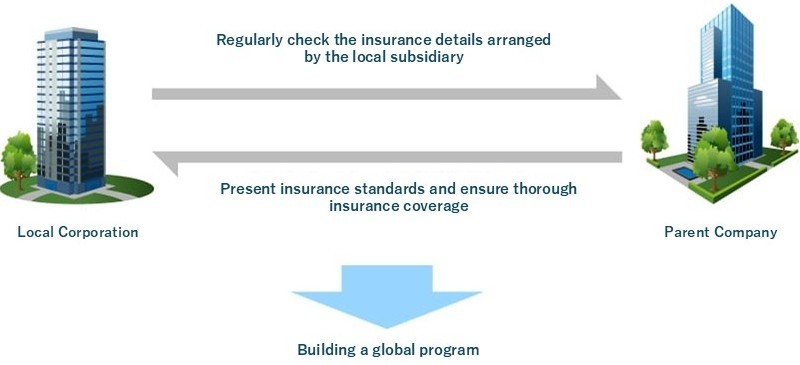
It is essential for any company to have close collaboration with its overseas bases. However, insurance matters are left to the discretion of local offices. This is a common challenge. Kyoritsu provides centralized insurance management by offering transparency into the insurance arrangement of overseas bases.
Many problems may arise due to insufficient awareness of insurance coverage arranged by global subsidiaries.
Do you have these problems?
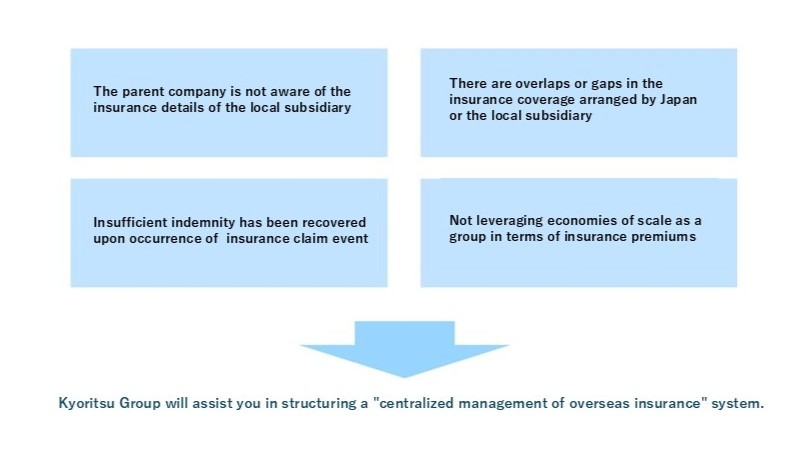
“Centralized management of overseas insurance” means that the head office must first accurately grasp and manage the insurance coverages arranged by the overseas affiliates. Then, we establish unified insurance standards and revise the insurance conditions across countries to achieve appropriate insurance coverage. Furthermore, we aim to optimize insurance costs by developing regional programs and reviewing insurance companies.
The Kyoritsu Group and its overseas bases support global insurance management with an expert perspective.
Benefits of Introducing Overseas Insurance Review Consulting
- Transparency into the insurance management and administration process at overseas bases
- Faster insurance response in the event of an accident
- Achieving appropriate insurance coverage through the standardizing insurance standards
- Controlling and reducing insurance costs
- Reducing insurance administration costs
- Acquiring insurance coverage and capacity for high-risk exposures
Example of "Overseas Insurance Review"
Example of reviewing Liability Insurance Policies arranged by Overseas Affiliates
Outline
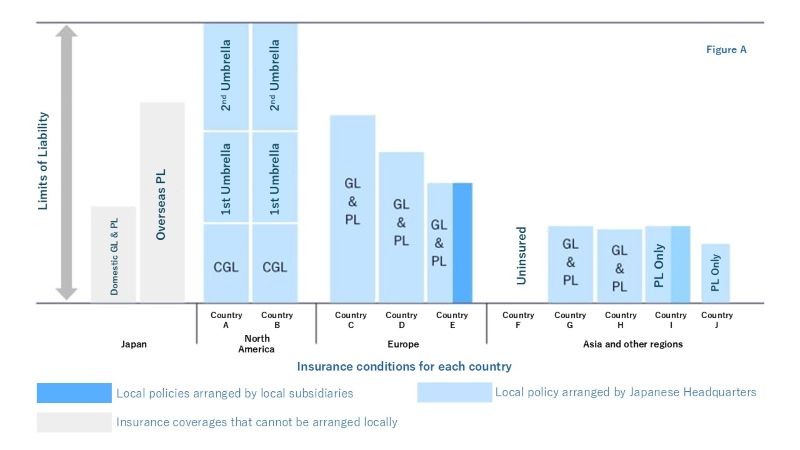
This case involves a situation overseas insurance arrangement were delegated to local subsidiaries, which arranged insurance independently, resulting in a discrepancy in the insurance coverages and limit of liability among the Japanese parent company and the overseas local subsidiaries (Figure A).
- Differences in Insurance Coverages
(Example) Arranging PL (Product Liability Insurance) and GL (General Liability Insurance)
(Example) Financial Loss Caused by Defective Finished Products - Differences in Liability Limits
- Various (Different) Insurance Carriers
Points of Concern
- If an accident occurs at an overseas subsidiary with insufficient limits of liability, the subsidiary may be forced to bear a large amount of the costs itself, which could result in reduced profits.
- From the perspective of risk management for the entire group, the scope of coverage and the limits of liability are not set neither rationally nor uniformly.
- Economies of scale across the group may not be properly reflected in the current premiums.
Solutions Recommended by Kyoritsu Group
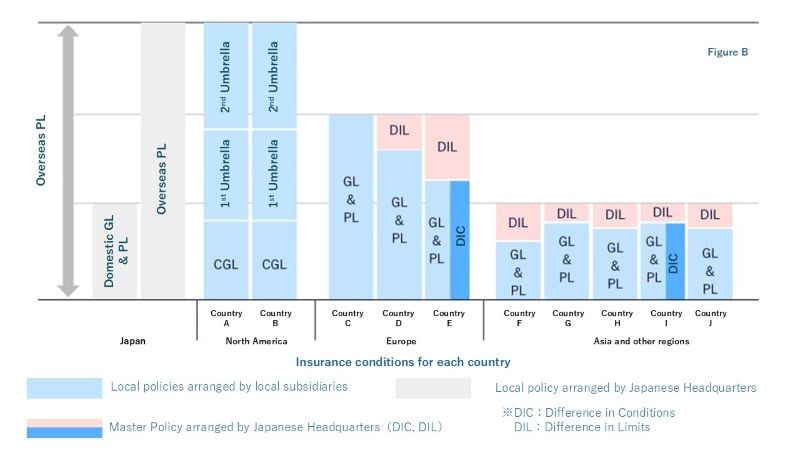
- We examine and analyze the insurance coverage arranged by each overseas subsidiary.
- The Japanese Headquarters establishes global standards (insurance standards) for insurance coverage, limits of liability, etc.
- If it is possible to obtain similar coverage based on the global standards newly created, local subsidiaries will rearrange their local policies accordingly.
- In the event that appropriate coverages cannot be arranged locally or an unexpectedly large claim for damages arises locally, we will design a program scheme whereby the Japanese headquarters will arrange a master policy for the local subsidiary.
- In addition, we aim to reduce insurance premiums by leveraging economies of scale by having a single insurance company administer the master policy and local policies for each country.