Preparing for the Unexpected Will Determine the Company’s Future
In recent years, large-scale natural disasters such as earthquakes and floods have become more frequent.
When a company's activities are severely damaged by a large-scale natural disaster, fire, explosion, or other unexpected events, attention is being focused on BCP (Business Continuity Plan) and BCM (Business Continuity Management) to continue business operations and minimize the impact on performance.
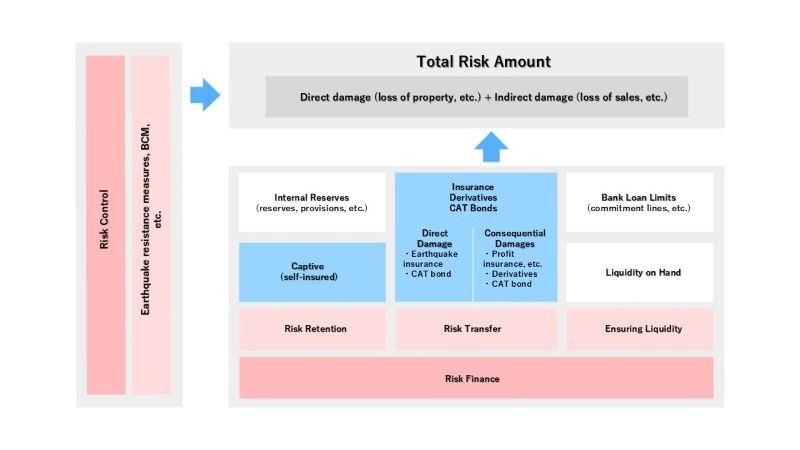
When considering BCM, insurance covering business interruption risks is becoming increasingly important. Kyoritsu supports BCM from the perspective of risk finance, including business interruption insurance coverages and earthquake risk countermeasures.
Handling of Business Interruption Risks
Business interruptions caused by large-scale disasters can have a significant impact on a company's finances, including reduced production and profits. In addition, due to the development of supply chains, the impact can extend beyond the company itself to a wide range of business partners, which can result in the company being held liable as a supplier or in a decline in its brand image.
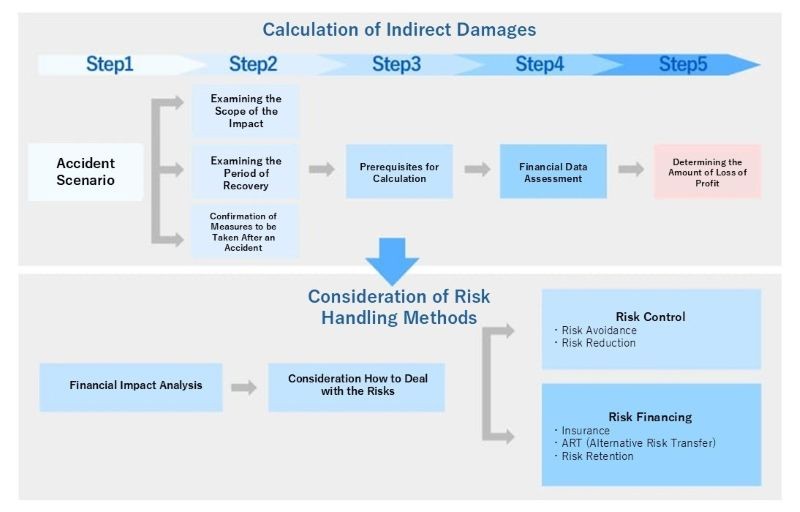
business interruption, such as reduced profits due to reduced sales and increased expenses. However, in Japan, although measures against direct property damage, such as fire insurance, are taken, the reality is that few companies have insurance products that cover the risk of indirect losses due to business interruption.
Kyoritsu reviews companies' insurance risk management from the perspective of BCM and supports to deal with business interruption risks.
We create hypothetical scenarios of accidents, simulate the impact of the accidents on cost fluctuations and operating profit fluctuations, and calculate the amount of loss of profit. We also propose general insurance products and/or ART (Alternative Risk Transfer) solutions as risk financing methods.
Responding to Earthquake Risks
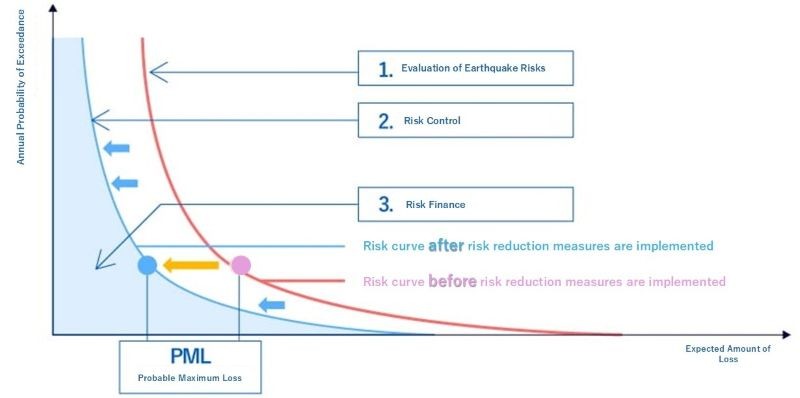
Evaluation of Earthquake Risk
Risk Control
Risk Finance
We arrange earthquake insurance and introduce earthquake derivatives and CAT bonds as a means of transferring earthquake risk.
In addition, since the Great East Japan Earthquake, underwriting earthquake insurance and issuing earthquake derivatives or CAT bonds has become increasingly challenging, but if you consult with Kyoritsu, we can provide insights into the market situation and possible measures.
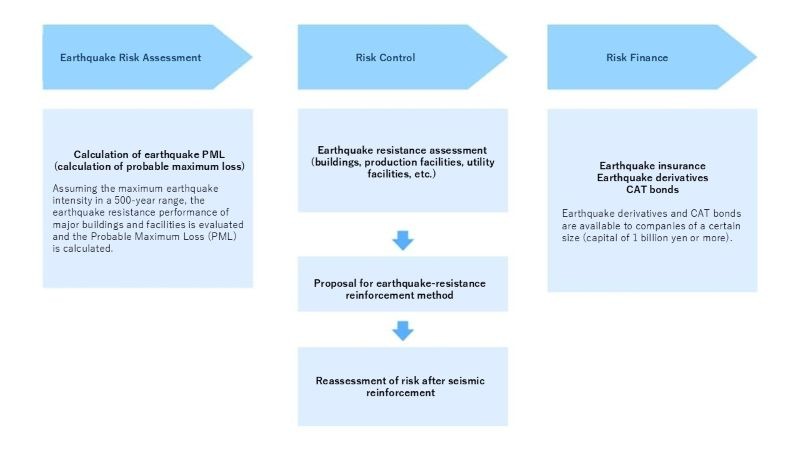
Overall image of earthquake risk response